
US President-elect Donald Trump has nominated Indian-American scientist Jay Bhattacharya to lead the National Institutes of Health (NIH), the country's top health research and funding institutions. Bhattacharya, a professor of Health Policy at Stanford University, is known for his research on the health and well-being of vulnerable populations. Trump also nominated Jim O'Neill as the deputy secretary of Health and Human Services to work alongside Robert F. Kennedy Jr.
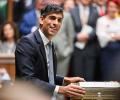
Former UK Prime Minister Rishi Sunak has taken on new academic roles at the University of Oxford and Stanford University, both alma maters of the Conservative Party member of Parliament. Sunak will join Oxford's Blavatnik School of Government as a member of the World Leaders Circle and a Distinguished Fellow, while at Stanford, he will be the William C Edwards Distinguished Visiting Fellow at the Hoover Institution. Sunak expressed his enthusiasm for contributing to both institutions, highlighting their leading research in global challenges, economic policy, and technological advancements. He emphasized the significance of his education at both universities in shaping his life and career. The appointments have been welcomed by both institutions, with leaders praising Sunak's expertise and experience in global affairs and economic policy.

'Our problem is not a budget deficit but a trust deficit. We need to trust our institutions and industries to innovate and lead. That is the way forward for India.'

Let's work flat out and create a policy framework that fosters the growth of Indian non-family business VC and private equity firms. This will allow our Indian startups' dreams to flourish, explains Ajit Balakrishnan.
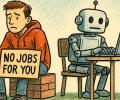
Generative AI is transforming workplaces but at a cost -- there are fewer jobs for young workers just entering the workforce, reveals a Goldman Sachs report.

India has its share of both large tech companies and large national laboratories, but why is it that these don't seem to be at the forefront of any innovation news headlines? asks Ajit Balakrishnan.

His 7-day long trip to the United States starts on June 17.

Jaitley exuded hope that the land reforms bill in its new shape would be able to get through the Rajya Sabha.

'Even though as Xi will seemingly continue to stay in power beyond his third term, competitions for the post-Xi leadership would be inevitably unfolded beneath the surface of water, and that will be a big headache for Xi the dictator.'

The dinner Jill Biden and her husband US President Joe Biden hosted for Indian prime minister Narendra Modi, June 22, at the White House brought together, Indians and Americans from so many firmaments.

I still believe that it is a good thing that think tanks are mushrooming in Delhi. They provide a platform for discussion, even if they shed more heat than light. With Parliament almost incapable of serious debate, informed discussion and civilised discourse, where does this nation get its intellectual churn, asks Mohan Guruswamy.

'There is no tried and true recipe for creating Silicon Valleys.' 'Attracting and creating a mass of truly dynamic entrepreneurs is at the core and among the hardest and most necessary ingredients.' 'In the US, close to 60% of the top valued tech companies were started by immigrants who found the start-up climate to be superior to where they came from.' 'India would clearly benefit from attracting back its talented Diaspora, but it also needs to hold onto those entrepreneurs.'

Saima Hasan, founder and chief executive officer of Roshni Academy that works to empower girls from government schools in New Delhi and surrounding areas to achieve their full potential in college, jobs and life in general, tells P Rajendran what drew her to help poor girls.

The Forbes 30 Under 30 list is harder to get into than Stanford or Harvard University. Meet the desis who made the cut this year.
 © 2026 Rediff.com - Advertise with us - Disclaimer - Privacy Policy - Sitemap - Feedback - About us - Terms of use - Grievances